Expert Articles
More Technical Articles
Short studies supporting the investment decision: energy, raw material, pellet mill design and documentation for funding.
Energy Efficiency
How to reduce energy consumption in biomass pelleting?
Nawrocki Knowledge Hub · approx. 3 min read
TL;DR
The biggest impact on energy consumption (kWh/t) comes from stable raw material moisture, the right die, even material feeding and automation keeping the machine at its nominal operating point. Savings start with measuring energy per tonne, not with the installed power itself.
In biomass pelleting, the cost of electricity is one of the largest items in a line's operating budget. That is why a real cost advantage is built not by increasing motor power, but by lowering the unit energy consumption — the number of kilowatt-hours needed to produce one tonne of finished pellet.
What does kWh/t really depend on?
- Raw material moisture — deviations from the optimal range increase pelleting resistance and reduce pellet durability.
- Die selection — the right ratio of thickness to hole diameter (compression) determines the extrusion resistance.
- Even feeding — surging feed causes operation away from the nominal point and energy losses.
- Process automation — the AIAC system keeps the machine at optimal load, limiting overheating and downtime.
Measurement instead of estimation
Without an energy meter and a flow scale, cost cannot be managed. Measuring kWh/t makes it possible to compare recipes, dies and settings objectively, and to catch wearing components before they show up on the bill.
The role of the motor and gearbox
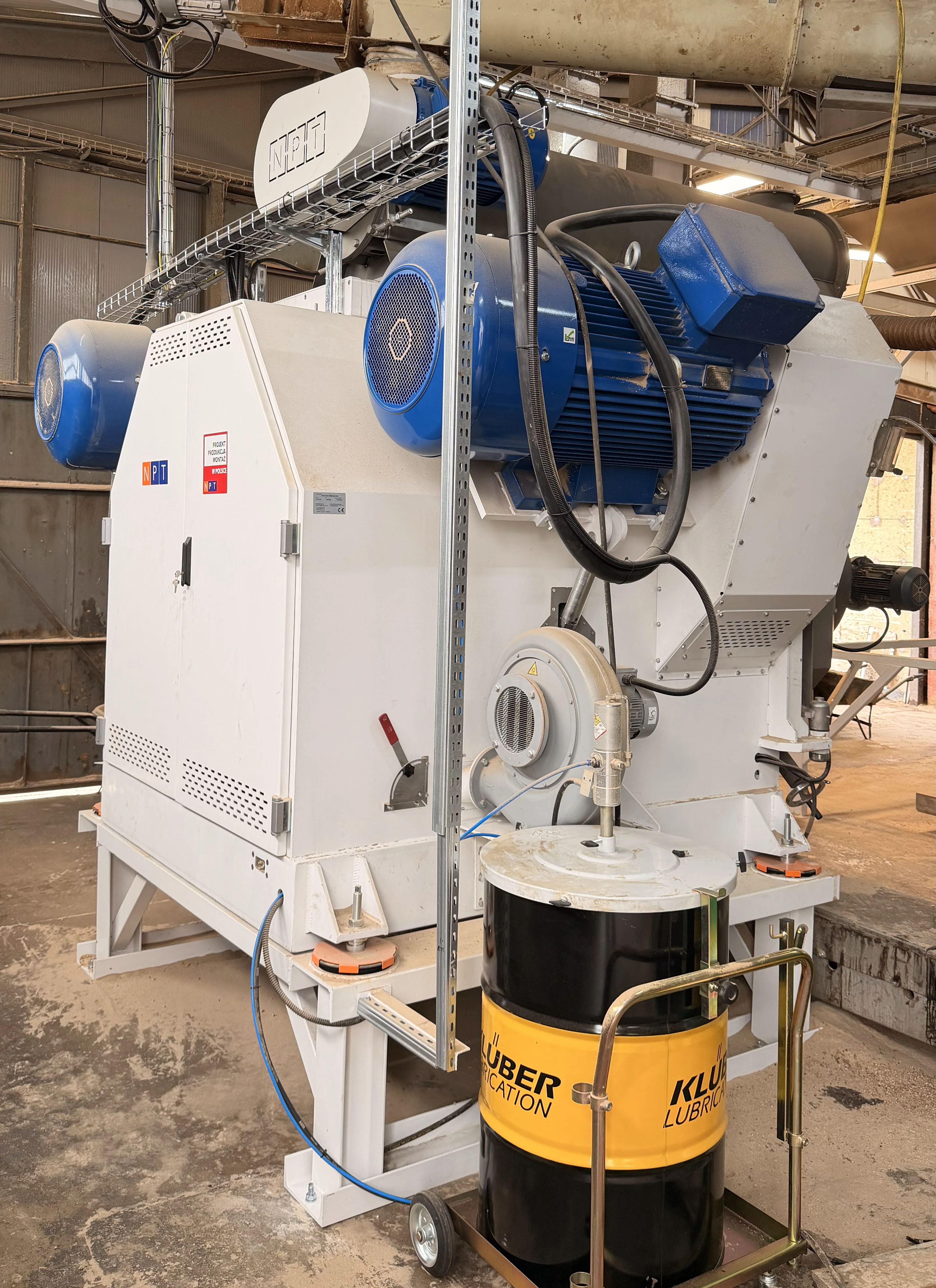
An IE3-class motor and a precise bevel-helical gearbox reduce mechanical losses, but their potential only shows under stable, continuous load. GR series pellet mills are designed precisely for continuous operation at the nominal point.
FAQ — frequently asked questions
Does a more powerful motor mean higher energy consumption?
Not directly — what counts is the load and the operating point. A machine running steadily close to nominal power consumes less energy per tonne than an oversized unit working in surges.
How quickly does an investment in an energy-efficient line pay off?
It depends on energy prices and production volume — the ROI calculator lets you estimate this period for your own data.
energy consumption
kWh/t
energy efficiency
die
AIAC automation
Pelleting Technology
2 or 3 rollers? Differences in pellet mill design
Nawrocki Knowledge Hub · approx. 3 min read
TL;DR
A three-roller layout increases the frequency of material compaction around the die circumference and stabilises throughput at larger diameters. For the investor, this means more predictable operation at high throughputs and better use of the die's working surface.
The number of rollers is one of the key design parameters of a ring-die pellet mill. It determines how often each part of the die is pressed in a single revolution, and therefore the evenness of operation and the maximum throughput.
Two-roller layout
It works well in small and medium machines and with raw materials that are easy to pelletise. It is simpler to service and cheaper to run, and at moderate throughputs it provides fully stable operation.
Three-roller layout
At larger die diameters, the third roller shortens the interval between successive pressing cycles. The material is compacted more often and more evenly, which translates into higher and more stable throughput and smaller fluctuations in motor load.
What does this mean for the investor?
- Predictability — smaller throughput fluctuations in continuous operation.
- Die utilisation — more even wear of the working surface.
- Scaling — the three-roller layout copes better with the high throughputs of large models, e.g. the GR 880.
FAQ — frequently asked questions
Does more rollers always mean better?
No — the choice depends on the die diameter, the type of raw material and the target throughput. For smaller lines, the two-roller layout can be optimal.
Does the number of rollers affect the cost of wear parts?
Yes — more rollers means more sliding components, but more even die wear can extend its service life.
pellet mill design
rollers
ring die
throughput
GR series
EU Market
Wood pellet market in the EU — trends and forecasts
Nawrocki Knowledge Hub · approx. 3 min read
TL;DR
A pellet producer in the EU now competes not only on the price per tonne, but also on quality repeatability, energy cost and the ability to document process efficiency. Lines with lower energy consumption defend their margin more easily amid volatile electricity and raw material prices.
The wood pellet market in the European Union is growing along with the decarbonisation policy for heating and distributed energy. At the same time, it is becoming increasingly demanding — buyers expect certified quality and stable supplies.
Key trends
- Certified quality — standards such as the ENplus A1 class are becoming a condition for entering the premium market.
- Energy cost pressure — volatile electricity prices reward lines with low kWh/t.
- Shorter supply chains — local raw material and production close to the buyer are gaining importance.
- Documenting efficiency — audits and certificates support investment financing.
How to maintain the margin?
An advantage is built through quality repeatability and low unit cost. A stable process — from raw material preparation to pelleting — reduces complaints and allows sales to be planned in the premium segment, which is less sensitive to price fluctuations.
The role of technology
GR series machines are designed for continuous operation and repeatable pellet quality, which translates directly into the producer's position in the demanding EU market environment.
FAQ — frequently asked questions
Is it worth entering the pellet market today?
Yes, if the investment assumes certified quality and low energy cost — these two factors determine the durability of the margin.
Which pellet applications have the most potential?
Municipal heating, industrial energy and the consumer market for premium-class fuels — you will find an overview of applications on the dedicated page.
pellet market
EU
ENplus
margin
wood pellet
White Certificates
Step by step: how to apply for white certificates
Nawrocki Knowledge Hub · approx. 3 min read
TL;DR
The process starts before purchasing the machine: you need to define the baseline, gather data on current energy consumption and prepare an energy efficiency audit. Only then is the application submitted to URE, and the pellet mill's technical data becomes part of the justification of savings.
White certificates (energy efficiency certificates) are issued by the Energy Regulatory Office. To obtain them, proper preparation of the application is crucial — and most of the work is done before purchasing a new line.
Order of actions
- 1. Baseline — gathering data on current energy consumption and process parameters.
- 2. Energy efficiency audit — comparing the current state with the planned investment and calculating annual savings.
- 3. Application to URE — submitting the documentation before carrying out the project.
- 4. Implementation and confirmation — implementing the investment and verifying the savings achieved.
Why does the order matter?
The application should be submitted before the project is carried out. Submitting it after the fact makes obtaining the certificate significantly harder or impossible, so it is worth combining certificate planning with the choice of technology supplier.
The role of the pellet mill's technical data
The machine's parameters — power, efficiency, unit energy consumption — become part of the justification of savings. The better documented they are, the stronger the application.
FAQ — frequently asked questions
Can I apply after purchasing the machine?
As a rule, the application is submitted before carrying out the investment. Submitting it after the fact usually rules out obtaining the certificate.
Who prepares the audit?
The audit is carried out by a certified energy efficiency auditor, preferably in cooperation with the technology supplier.
white certificates
URE
energy audit
application
funding
Pelleting Technology
Raw material moisture and pellet quality — what you need to know
Nawrocki Knowledge Hub · approx. 3 min read
TL;DR
Raw material that is too dry increases resistance and reduces pellet durability, while material that is too wet lowers process stability and requires more drying control. Measuring moisture at the inlet is one of the simplest ways to reduce energy losses and quality complaints.
Raw material moisture is one of the most important — and most often underestimated — parameters of the pelleting process. It affects pellet durability, energy consumption and the stability of machine operation all at once.
Too dry and too wet
- Raw material too dry — extrusion resistance through the die rises, the pellet can be brittle, and energy and parts consumption increases.
- Raw material too wet — the process loses stability, there is a risk of clogging and a need for more intensive drying.
Optimal moisture window
For most wood biomass, the optimal range lies within a narrow window that is worth establishing experimentally for the given raw material and recipe. Keeping to this window determines the repeatability of quality.
Measurement and control
Measuring moisture at the inlet, combined with a steam conditioner and process automation, makes it possible to react quickly to changes in raw material batches. This is the cheapest way to reduce energy losses and quality complaints.
FAQ — frequently asked questions
What moisture is best?
It depends on the raw material and recipe — the key is stability, not a single value. The optimal window is established for the specific material.
Does a steam conditioner help?
Yes — steam softens the raw material and supports binding, improving pellet durability and lowering pelleting resistance.
raw material moisture
pellet quality
conditioner
pellet durability
biomass
Energy Efficiency
Simultaneity factor in industrial installations
Nawrocki Knowledge Hub · approx. 3 min read
TL;DR
Installed power is not the same as actual energy draw. In an ROI calculation you have to account for motor load, running time under full feed, technological stoppages and auxiliary equipment — only such a picture shows the real energy cost per tonne of product.
The simultaneity factor describes what portion of the installed power actually operates at the same time. In industrial installations, all devices rarely reach their maximum at once — and that is precisely why installed power overstates the estimated energy consumption.
Why is this important?
- Real energy cost — what counts is the actual draw, not the sum of rated powers.
- Connection sizing — overestimation leads to overly expensive supply infrastructure.
- Credible ROI — a calculation based on the load profile is closer to reality.
What to include in the calculation
A reliable calculation must include the load of the main motor, running time under full feed, technological stoppages (die replacement, cleaning) and auxiliary equipment — feeders, the conditioner, the cooler and the dedusting system. Only their combined profile gives the energy cost per tonne of finished pellet.
How to translate this into an investment decision?
Instead of comparing machines by rated power, it is worth comparing them by energy cost per tonne under a real operating profile. Such a picture is provided by the ROI calculator, which accounts for the line's load and running time.
FAQ — frequently asked questions
Is the simultaneity factor always less than 1?
In the practice of industrial installations — yes, because not all loads operate at maximum power at the same moment.
How can I estimate it for my own line?
Best of all based on energy draw measurements during operation; at the planning stage, the ROI calculator helps to estimate this.
simultaneity factor
installed power
ROI
energy cost
industrial installations